8. DataQL engine
The DataQL engine compiles scripts into QIL and executes them directly in Java applications. Create queries through HostConfiguration → QueryManager → QueryBuilder → Query and supply parameters at execution time.
Compilation and execution
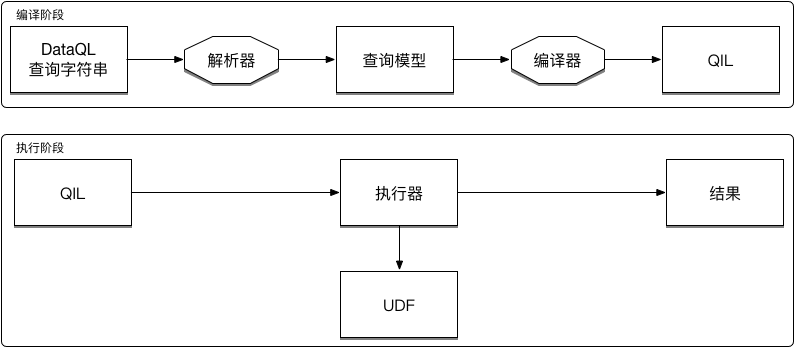
The parser creates a query model, which the compiler turns into QIL. The executor runs the instructions, invokes UDFs as needed and returns the query result.
Add the dependency
pom.xml
<dependency>
    <groupId>net.hasor</groupId>
    <artifactId>dataql-engine</artifactId>
    <version>5.0.0</version>
</dependency>
Run your first query
QueryExample.java
import java.util.Map;
import net.hasor.dataql.host.HostConfiguration;
import net.hasor.dataql.host.Query;
import net.hasor.dataql.host.QueryManager;
import net.hasor.dataql.kernel.QueryResult;

public class QueryExample {
    public static void main(String[] args) throws Exception {
        HostConfiguration host = new HostConfiguration();
        QueryManager manager = new QueryManager(host);
        Query query = manager.newBuilder().createQuery("return ${name};");
        QueryResult result = query.execute(Map.of("name", "DataQL"));
        System.out.println(result.getData().unwrap());
    }
}
The script reads the supplied parameter through ${name}. result.getData().unwrap() converts the result into a Java object. Running the example prints:
DataQL
Guides
- Standalone usage: Supply parameters, reuse compiled code and handle results.
- Data models: Convert Java data, read results and handle binary resources.
- Core APIs: Understand configuration, builders, queries and result objects.
- SQL executor: Add SQL execution and configure database connections.
- JSR-223: Execute and precompile queries through the JDK scripting APIs.
- QIL instruction reference: Look up instructions when inspecting compiled code.
For functions, fragments, Finders and scopes, see Engine extensions.