4.2 Parameters and context
DataQL uses $, @ and # to access parameters or data during a transformation. Braces distinguish parameter access from transformation context access.
Parameter access
| Syntax | Meaning |
|---|---|
${name} | Read name from the $ parameter scope |
@{name} | Read name from the @ parameter scope |
#{name} | Read name from the # parameter scope |
Each scope can contain a parameter with the same name. When the host supplies a name value in all three scopes, read them as follows:
return {"request": ${name}, "application": @{name}, "custom": #{name}};
The application supplies the contents of these scopes. Dataway exposes request parameters through $; the application configures @ and #. See Custom scopes.
Transformation contexts
The => transformation pushes its input onto the context stack. Nested transformations add further levels.
| Syntax | Meaning |
|---|---|
#, #.name | The current input and one of its fields |
$, $.name | The outermost input and one of its fields |
@, @[0] | The complete context stack and an indexed level |
var data = {
    "id": 10,
    "user": {"name": "Alice"}
};
return data => {
    "user": user => {
        "name",
        "ownerId": $.id
    }
};
The result is {"user":{"name":"Alice","ownerId":10}}. List transformations also add iteration levels. Choose an index according to the actual nesting depth.
Read parent nodes recursively
A list transformation pushes the list and then its current item onto the context stack, removing these levels when the transformation finishes. @[0] reads from the bottom; @[-1] reads from the top. This example transforms a tree recursively and adds parent_id to each child:
var treeData = [
    {
        "id": 1,
        "label": "t1",
        "children": [
            {
                "id": 2,
                "label": "t2",
                "children": [
                    {"id": 4, "label": "t4", "children": []}
                ]
            },
            {"id": 3, "label": "t3", "children": []}
        ]
    },
    {"id": 5, "label": "t5", "children": []}
]

var treeFmt = (dat) -> {
    return {
        "id": dat.id,
        "parent_id": ((@[-3] != null) ? @[-3].id : null),
        "label": dat.label,
        "children": dat.children => [ treeFmt(#) ]
    }
}

return treeData => [ treeFmt(#) ]
When processing the node with id = 4, the stack contains six levels:
| Position | Data |
|---|---|
@[-1], # | The current node, id = 4 |
@[-2] | The parent's children list |
@[-3] | The parent node, id = 2 |
@[-4] | The children list of the node with id = 1 |
@[-5] | The node with id = 1 |
@[-6], $ | The outermost treeData list |
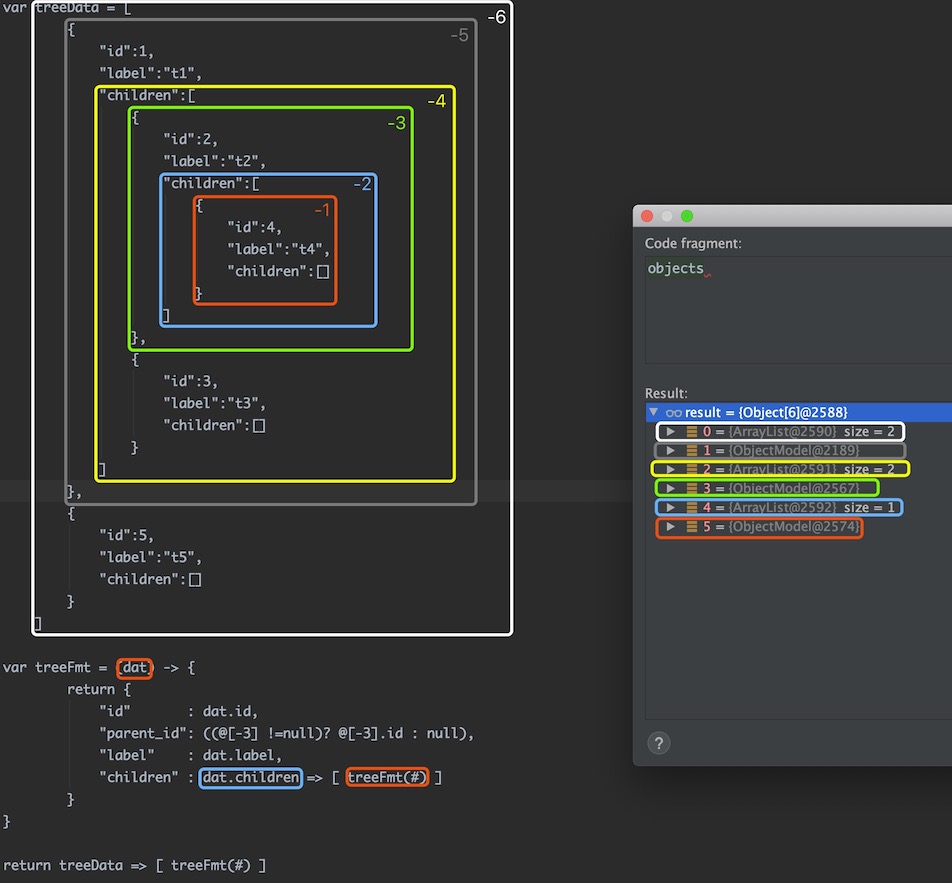
Here, @[-3].id reads the parent's ID. The index depends on the transformation depth; adjust it when adding another transformation level.
The result follows. Root nodes have a null parent ID, omitted from this JSON output:
[
    {
        "id": 1,
        "label": "t1",
        "children": [
            {
                "id": 2,
                "parent_id": 1,
                "label": "t2",
                "children": [
                    {"id": 4, "parent_id": 2, "label": "t4", "children": []}
                ]
            },
            {"id": 3, "parent_id": 1, "label": "t3", "children": []}
        ]
    },
    {"id": 5, "label": "t5", "children": []}
]
Variables and fields with the same name
Without an access symbol, DataQL first checks visible local variables and then fields of the current transformation input. Use #.fieldName to read a field explicitly.
var name = 'local';
var data = {"name": "Alice"};
return data => {"variable": name, "field": #.name};
The result is {"variable":"local","field":"Alice"}. ${name} always reads a parameter; $.name reads a field of the outermost transformation input.